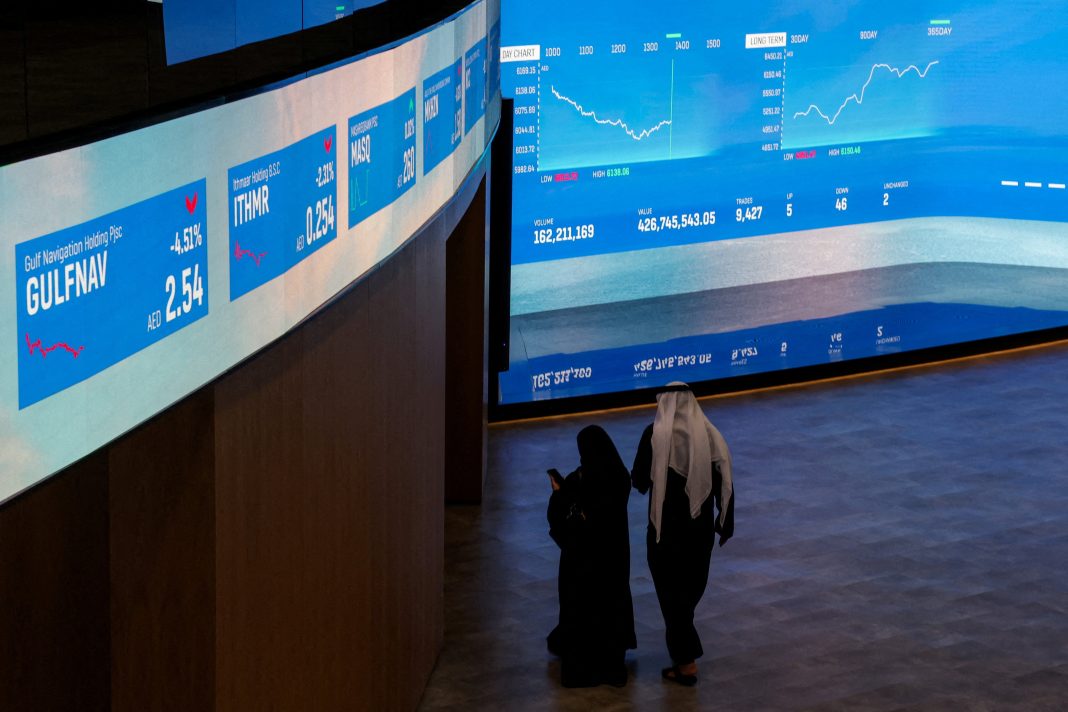

Most Gulf stock markets finished lower on Monday, as investors across the region adopted a cautious approach ahead of fresh diplomatic talks between the United States and Iran. Persistent uncertainty over geopolitical tensions weighed on trading sentiment, even as some indices showed pockets of resilience.
Washington and Tehran are set to meet for a second round of discussions in Geneva on Tuesday, aiming to resolve concerns over Iran’s nuclear programme and avoid further escalation. While the diplomatic push has raised hopes for easing tensions, reports that the US military is preparing contingency plans in case of conflict have kept regional markets on edge.
Saudi Arabia’s Tadawul All Share Index fell 0.4 per cent, closing at 11,184 points. Financial and energy heavyweights led the decline, with Saudi National Bank dropping 1.3 per cent and Saudi Aramco losing 0.7 per cent.
In the UAE, Dubai’s DFM General Index also slipped 0.4 per cent to 6,702 points, weighed down by a 1.2 per cent drop in Emaar Properties. Abu Dhabi’s FTSE ADX General Index edged down 0.1 per cent to 10,623.
Qatar’s main index mirrored the trend, down 0.4 per cent, as Industries Qatar slid 2.2 per cent. Outside the Gulf, Egypt’s EGX 30 retreated 1.5 per cent from record highs after the previous session’s rally, following a 100-basis-point interest rate cut.
Oil prices, a key factor for Gulf markets, remained steady as traders weighed the prospects of diplomatic progress against the potential for increased OPEC+ supply. Analysts noted that while strong corporate earnings and solid economic fundamentals could support a market rebound, for now, headlines and oil price swings are steering the direction.
Not all markets were in the red: Bahrain’s index inched up 0.1 per cent, Oman surged 2.2 per cent, and Kuwait added 0.3 per cent—offering some optimism amid broader caution.